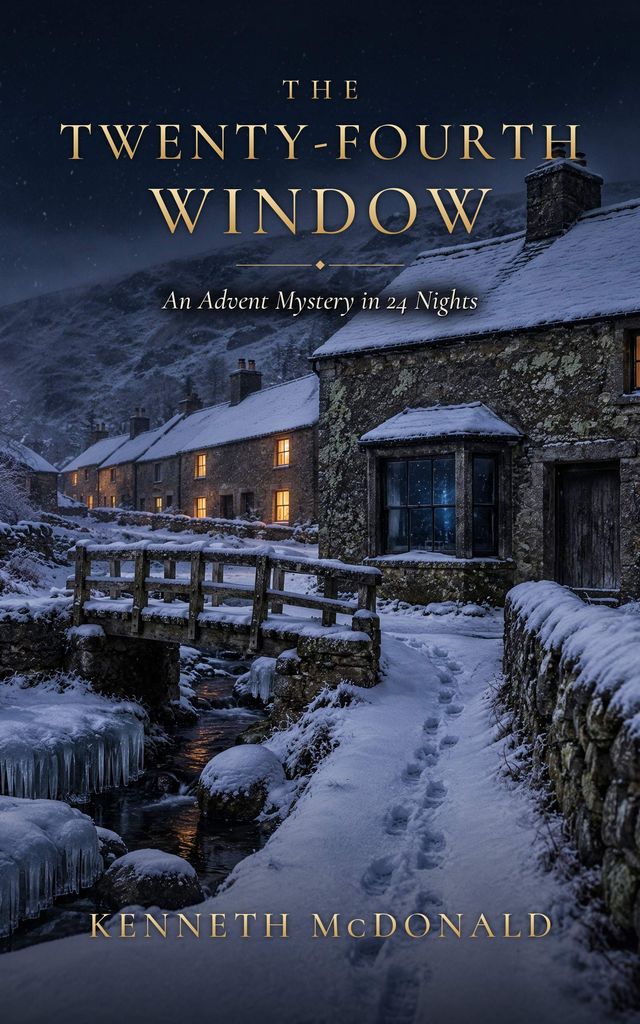
The Twenty-Fourth Window
Each night in December one household uncovers a window that it has dressed in secret, and the neighbours stand in the lane to see it. The last window, on Christmas Eve, belongs to a man named Leonard Garside. He has told nobody what is in it.
Hester Quill did that work in English courtrooms for thirty-four years. A court reporter does not write what a witness meant, or what a witness ought to have said. She writes the words. In this book you are given her notebook at the end of every chapter, and nothing she uses is kept from you.
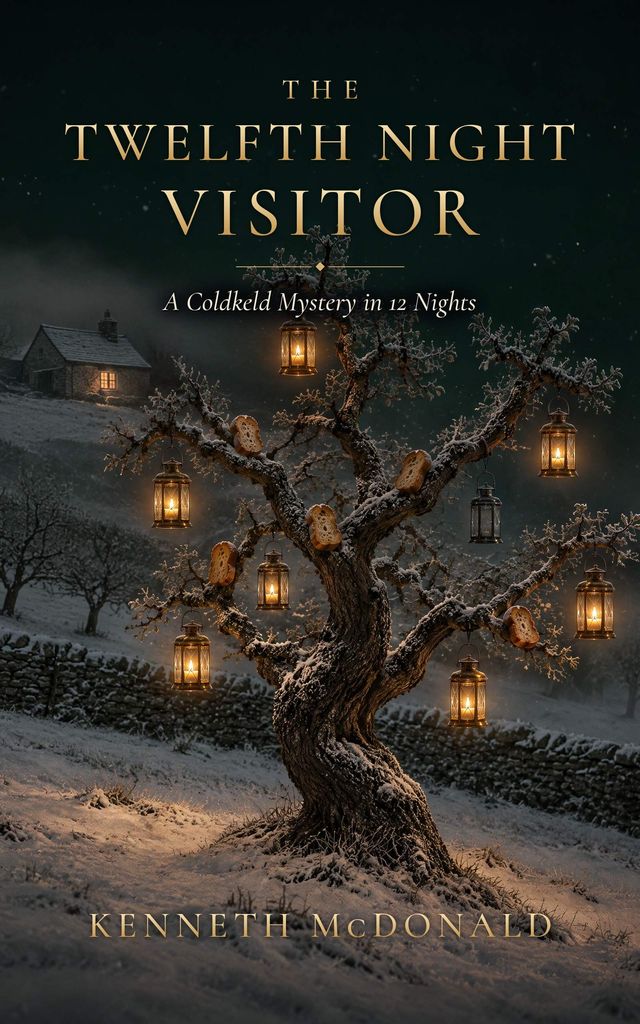
The Twelfth Night Visitor
This book begins on that morning. It is Christmas Day in Coldkeld, the first of the Twelve Days of Christmas, which run from the twenty-fifth of December to Twelfth Night on the fifth of January. A visitor comes to Coldkeld in these twelve days. She is welcome, and she is good company.
It is a fair mystery. Hester Quill writes down what people say, word for word, and at the end of each chapter you are shown the lines that she kept. Every fact that she uses to reach the answer is on the page, in the chapter or in her notebook lines, before she uses it.
Tonight’s four
After each chapter comes a short section called Tonight’s four.
Read
Gives the time the chapter takes, aloud and silently.
Talk
One question for the people you read with.
Write
One line for a notebook of your own, kept the way Hester keeps hers.
Share
One small thing to do or say before the next night.
Nothing in Tonight’s four gives the answer away. (From the books’ own “How to read this book”.)
What is real
The Twenty-Fourth Window
Coldkeld is invented, but its custom is not. In villages and towns in Switzerland, Germany and Britain, households really do take one night of Advent each, dress a window, and uncover it for their neighbours, so that the place becomes a calendar that people walk through.
The feast days fall where the story puts them: Saint Nicholas on the sixth of December, Saint Lucy on the thirteenth, and the winter solstice, in 2026, on the twenty-first. The saffron buns are real, and so is the crown of candles.
Price codes were a real habit of the auction and antiques trades. Any word of ten letters with no letter repeated will serve, and a firm kept its word to itself.
The woodcarvers of southern Germany around the year 1500, Tilman Riemenschneider and Veit Stoss among them, did work in limewood, and their carvings are among the finest ever made.
The line in Hester’s own window is from the Gospel of John, chapter one, verse five, in the King James Bible of 1611.
The Twelfth Night Visitor
The customs in this book are real ones. The twenty-eighth of December is the feast of the Holy Innocents, once called Childermas and counted an unlucky day. First-footing is still kept on New Year’s Eve in the north of England and in Scotland. A Twelfth cake with a bean and a pea was the centre of Twelfth Night in Britain for centuries. Apple trees are still wassailed in January.
Woodcarvers in the south of Germany around the year 1500 did hollow out the backs of their limewood figures, so that the wood could shrink as it dried without splitting. The village of Oberammergau in Bavaria has carved religious figures for travellers since at least the eighteenth century.
In England and Wales, fraud by false representation has been a crime in its own right since the Fraud Act 2006 came into force in January 2007, and going into a building without permission and stealing from it is burglary under the Theft Act 1968.